

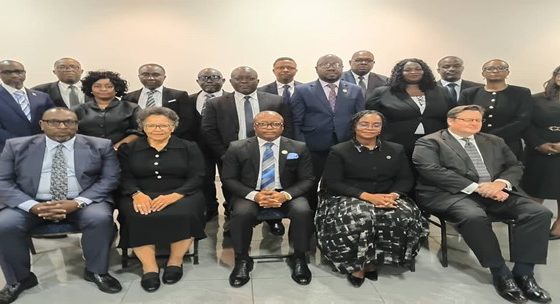

Sierra Leone’s Chief Justice, His Lordship Honourable Justice Komba Kamanda, has officially declared open a three-day capacity-building training for High Court Judges, reaffirming the Judiciary’s commitment to judicial independence, institutional accountability, and the continuous strengthening of the administration of justice.
In his opening address, the Honourable Chief Justice described the training as part of the Judiciary’s ongoing efforts to enhance the knowledge, competence, and professionalism of judicial officers while promoting public trust and confidence in the justice system.
According to him, such professional development programmes are essential to ensuring that judges remain independent, accountable, and responsive to the evolving demands of justice.
The training focuses on contemporary issues affecting the administration of justice, the Rule of Law, Separation of Powers, the Role of a Judge in a Democracy, Cybersecurity for Judges, Judicial Independence, Modern Statutory Interpretation, Judges and Social Media, Identification of Common Case Management Problems and Possible Solutions, and other emerging areas of judicial practice.
He further stated that his administration remains firmly committed to judicial reforms aimed at strengthening the efficiency, integrity, and credibility of the Judiciary.
“This training will strengthen our analytical skills and help us think outside the box in addressing complex legal issues and the evolving challenges confronting the Judiciary,” Chief Justice Kamanda said.
In his pre-recorded video presentation, the former Lord Chief Justice of England and Wales, Lord Thomas emphasised that the Rule of Law is fundamental to economic prosperity, democratic governance, and the development of a stable and prosperous society.
Speaking on the doctrine of the Separation of Powers, Lord Thomas explained that it requires a clear division of responsibilities among the three arms of Government, each exercising its constitutional mandate independently and without undue interference, thereby ensuring effective governance and the protection of constitutional democracy.
He further stressed that the Judiciary must discharge its constitutional responsibilities in a transparent, impartial, and accountable manner in order to maintain public confidence.
Delivering a presentation on Judicial Ethics, Independence and Accountability, retired United Kingdom Judge, Honourable Dame Linda Dobbs, highlighted the fundamental ethical principles that underpin judicial office. She also examined the opportunities and challenges associated with judges’ use of social media, drawing practical lessons from the Judicial Codes of Conduct in the United Kingdom and the United States.
Presenting on The Role of a Judge in a Democracy, Professor Richard Honey discussed the constitutional responsibilities of judges in safeguarding the Rule of Law, protecting fundamental rights, and preserving public confidence in the justice system. He also outlined the essential qualities of a good judge, including integrity, impartiality, independence, competence, diligence, courage, humility, and sound judicial temperament.